

For our State of Meetings report, we looked at 50.9 million hours of real meetings captured between 2023 and 2025, and a handful of formats turned out to make up most of how teams meet.
So here are the six most common types of meetings by real volume, what each one's for, and how to run it so people leave with a clear next step. They're ordered by how often they actually happen.
1. Sync and check-in meetings
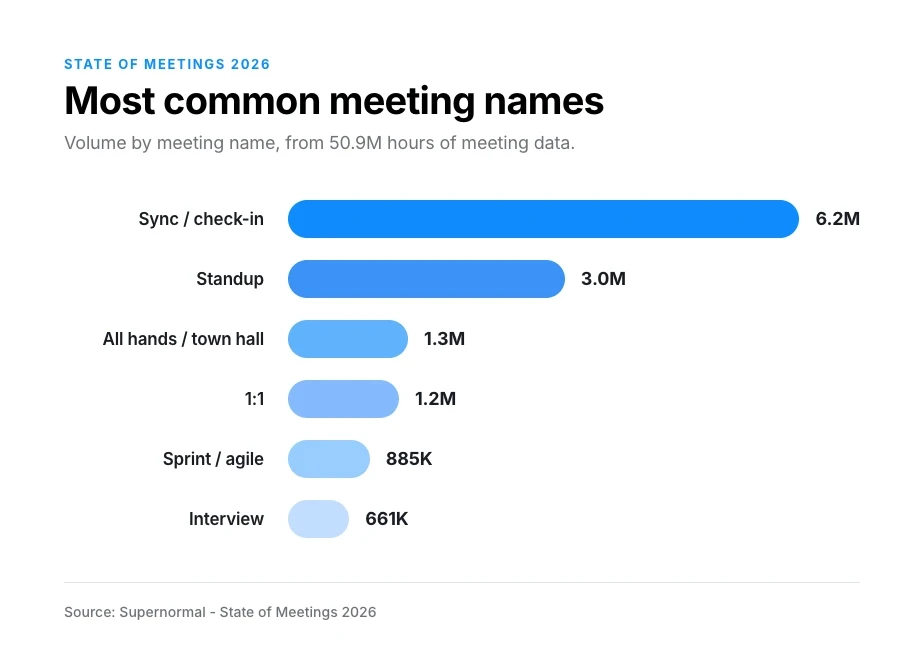
Sync and check-in meetings are the single most common type in our data, with 6.2 million captured. They're recurring conversations where a team or a few collaborators align on progress, dependencies, and what's next.
When to use it: when a group needs shared visibility and coordination on an ongoing basis, not when one person just needs a quick answer.
How to run it well: keep it tight and predictable, give it a consistent structure, and capture decisions and blockers as you go so it produces a record rather than just talk. For recurring formats specifically, see our guide to effective recurring team meetings.
Common pitfall: letting a check-in sprawl into problem-solving. If something needs real discussion, take it offline and keep the sync moving.
2. Standups
Standups are second by volume at 3.0 million meetings, and together with syncs they account for more meetings than every other named type combined. A standup is a short, daily cadence where a team shares quick updates and surfaces blockers. They're also the most likely meeting to draw a crowd: 45% of standups in our data have 10 or more attendees.
When to use it: when a team is moving fast day to day and needs a brief, regular pulse check.
How to run it well: keep it to a strict time box and a simple format, for example what you did, what's next, and what's blocking you. Hold deeper discussions for a separate session.
Common pitfall: letting it run long. A 30-minute standup isn't a standup anymore.
3. All-hands and town halls
All-hands and town halls (1.3 million meetings) are how leaders share company or org-wide updates. They consistently draw the largest crowds in our data, often well past 10 attendees, because the whole point is reaching everyone at once.
When to use it: when the same message needs to land with a whole team, department, or company, and a live moment adds something a written update can't.
How to run it well: lead with the headline, prepare your materials in advance, and protect real time for questions so it isn't purely one-directional. Our guide to running impactful all-staff meetings covers this in detail.
Common pitfall: reading slides aloud. If there's no discussion or Q&A, a recording often respects everyone's time more.
4. One-on-ones
One-on-ones (1.2 million meetings) are among the fastest-growing formats we track, and direct conversations now make up nearly a quarter of all meetings. They're a focused conversation between two people, usually a manager and a report, built for check-ins, mentorship, and decisions that don't need a wider audience. Unlike all-hands, they stay lean by design, typically just two people.
When to use it: when a single working relationship needs dedicated attention, whether that's coaching, feedback, or unblocking someone.
How to run it well: let the other person set part of the agenda, keep it consistent rather than canceling it when things get busy, and follow up on what you agreed last time. Our guide to successful one-on-one meetings has a full playbook.
Common pitfall: turning it into a status update. A one-on-one is for the conversation and connection a status meeting can't hold.
5. Sprint and agile ceremonies
Sprint and agile ceremonies (885,000 meetings) are the recurring rituals development teams run to plan, review, and improve: sprint planning, retrospectives, and backlog grooming. They blend several purposes, from deciding what to build next to working through what went wrong.
When to use it: when a team works in cycles and needs structured moments to plan the work and learn from the last round.
How to run it well: give each ceremony a single clear job, so planning doesn't bleed into a retro. For the retrospective in particular, separate diagnosing the cause from choosing the fix, and leave with owners and dates. See our guide to agile meetings.
Common pitfall: running ceremonies out of habit after they've stopped being useful. If a ritual isn't earning its place, change it.
6. Interviews
Interviews (661,000 meetings) round out the six. They're focused conversations to evaluate a candidate, and like one-on-ones they stay small, usually two to four people centered on a single decision.
When to use it: any time you're hiring, of course, but the same structure helps for vendor evaluations and other assessment conversations.
How to run it well: prepare consistent questions so you can compare candidates fairly, and capture notes during the conversation so your evaluation isn't running on memory afterward. Our guide to crafting the perfect interview script is a good place to start.
Common pitfall: winging the questions. Inconsistent interviews make fair comparison almost impossible.
The six most common meeting types at a glance
Meeting type | What it's for | Volume in our data | Typical size | Cadence |
|---|---|---|---|---|
Sync / check-in | Align on progress and dependencies | 6.2M | Small to mid team | Recurring |
Standup | Quick daily pulse and blockers | 3.0M | Often 10+ | Daily |
All-hands / town hall | Org-wide updates | 1.3M | Largest crowds | Monthly or as needed |
One-on-one | Coaching, feedback, focused decisions | 1.2M | 2 people | Weekly or biweekly |
Sprint / agile | Plan, review, and improve the work | 885K | Dev team | Per sprint |
Interview | Evaluate a candidate | 661K | 2 to 4 | As needed |
Other types worth knowing
The six above are the most common by volume, but a few other formats come up often enough to recognize, usually as variations on the types above:
Decision-making meetings exist to reach and commit to a choice. Board meetings and strategy sessions are decision-making meetings at their core.
Problem-solving meetings bring the right people together to work through a specific issue and agree on an action plan. Retrospectives and incident reviews are common examples.
Brainstorming meetings generate new ideas and options before anything gets judged or refined. Our roundup of tools for running brainstorming meetings is a good starting point.
Planning meetings set direction for a period, such as quarterly or annual planning.
Team-building meetings strengthen relationships and trust rather than produce a deliverable, from a structured offsite to a light recurring ritual.
A note on formal and informal meetings
You'll often see meetings split into two broad buckets: formal and informal. Formal meetings follow a set agenda and produce a record. Informal meetings are looser and conversational. That split cuts across all six types above. A one-on-one can be a casual coffee or a structured review, and a sync can be a quick huddle or a minuted status meeting. The format you choose depends on the stakes.
How to choose the right meeting
Before you send the invite, ask three questions: what outcome do you need, who genuinely needs to be there, and could this be handled without a live meeting at all. Our data shows teams are already getting more deliberate here, with average meeting length down from 51 to 47 minutes and longer meetings on the decline. The meetings that remain are the ones that earn their place.
How to capture any meeting without losing the thread
Whatever type of meeting you run, the value lives in what happens afterward: the decisions, the action items, and who owns what. Supernormal captures your meetings without a bot on the call, then turns them into clear notes and action items in moments, so you can stay present in the conversation instead of scribbling. From there you can turn the notes into follow-up messages and other deliverables that are ready to send.
You can see how it works on the meeting notetaker page.
The takeaway
These six types are what teams actually run most. Match the format to the outcome, keep a clear record of what gets decided, and a meeting earns its place.
Want the full picture of how teams meet today? Read the State of Meetings report.